
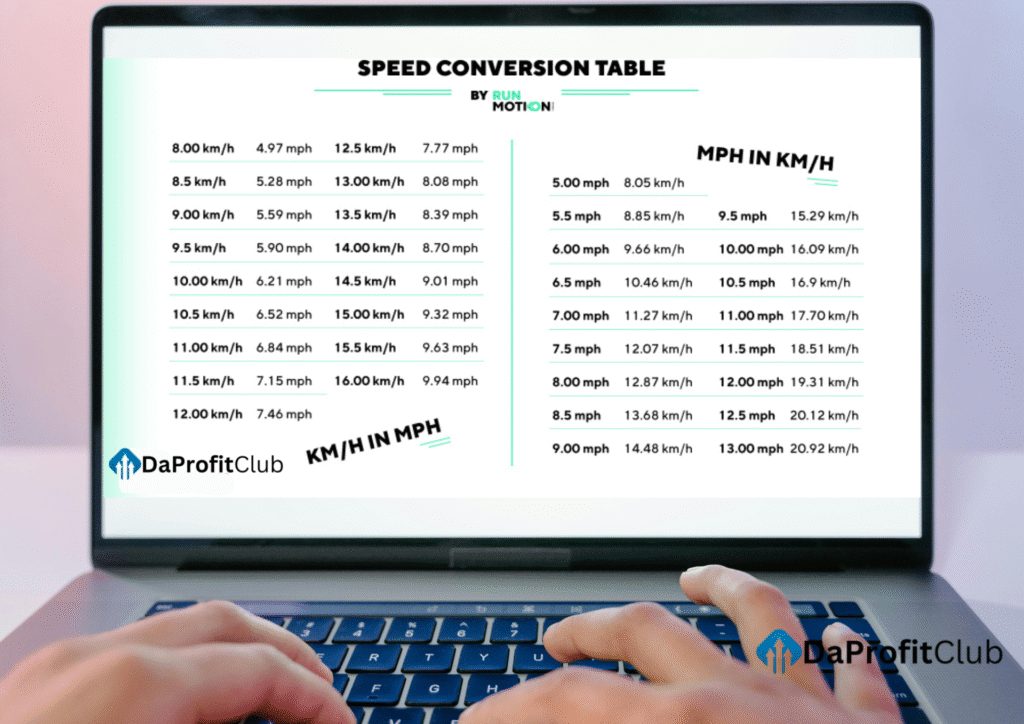

Speed Conversion Calculator
Conversion examples include: 250 KPH to MPH, 700 KPH to MPH, 120 MPH to M/S, 460 Knots to MPH, 250 MPH to Knots, 840 MPH to Knots, and 30 M/S to MPH.
Speed Conversion Guide: How to Convert MPH to KM/H, M/S, and Knots (With Real-World Uses)
Why Speed Conversions Matter
Whether you’re planning a road trip in Europe, analyzing athletic performance, or working in aviation, understanding speed units is essential. This guide simplifies conversions between MPH, KM/H, M/S, and Knots with practical examples, historical context, and trusted tools.
Key Speed Units Explained
Miles Per Hour (MPH)
Used in: US, UK, and some Caribbean nations.
Example: Highway speed limits (e.g., 65 MPH in the US).
Kilometers Per Hour (KM/H)
Global standard: Used in Europe, Canada, Australia, and most countries.
Example: Speed limits (e.g., 120 KM/H on German autobahns).
Meters Per Second (M/S)
Applications: Physics, weather reports, and engineering.
Example: Wind speeds in storms (e.g., 30 M/S ≈ 67 MPH).
Knots (KTS)
Used in: Aviation, maritime navigation.
Example: Cruise ships (~20 knots) or planes (500+ knots).
Source: International Bureau of Weights and Measures (BIPM).
Step-by-Step Conversion Formulas
1. MPH to KM/H (and Vice Versa)
Formula:
KM/H=MPH×1.609344orMPH=KM/H÷1.609344KM/H=MPH×1.609344orMPH=KM/H÷1.609344Real-World Example:
Driving Abroad: 60 MPH (US highway) = 96.56 KM/H (European equivalent).
Running Pace: A 10 KM/H jog ≈ 6.21 MPH.
2. MPH to M/S (and Vice Versa)
Formula:
M/S=MPH×0.44704orMPH=M/S×2.23694M/S=MPH×0.44704orMPH=M/S×2.23694Real-World Example:
Weather: 30 M/S wind ≈ 67.11 MPH (Category 1 hurricane).
3. MPH to Knots (and Vice Versa)
Formula:
Knots=MPH×0.868976orMPH=Knots×1.15078Knots=MPH×0.868976orMPH=Knots×1.15078Real-World Example:
Aviation: A Boeing 787 cruises at 560 MPH ≈ 486 Knots.
Quick Reference Table
| Common Speeds | MPH | KM/H | M/S | Knots |
|---|---|---|---|---|
| Highway Speed | 65 MPH | 104.6 KM/H | 29.06 M/S | 56.4 KTS |
| Marathon Runner | 12.5 KM/H | 7.75 MPH | 3.47 M/S | 6.75 KTS |
| Commercial Jet | 560 MPH | 901 KM/H | 250 M/S | 486 KTS |
Why Do We Use Different Units?
Historical Context:
MPH dates back to 18th-century British transportation.
Knots originated from sailors measuring speed with ropes and knots.
Regional Preferences:
The US retains MPH due to infrastructure costs of switching (source: NIST).
FAQ: Speed Conversions Made Simple
Q: How fast is 100 KM/H in MPH?
A: 62.14 MPH (common speed limit in Europe).
Q: Why do planes use knots?
A: Nautical miles align with latitude/longitude for easier navigation.
Q: How to convert treadmill M/S to MPH?
A: Multiply M/S by 2.23694 (e.g., 3 M/S ≈ 6.7 MPH).